
The U.S. national debt crossed $40 trillion last week, which has generated the predictable round of very large-number journalism. The number is real, but not especially useful.
At almost exactly the same time, perhaps as a knee-jerk reaction, long-dated Treasury yields rose. And Treasury Secretary Scott Bessent responded with an unscheduled announcement that Treasury would at least double its purchases of older long-dated bonds. If this sounds dramatic, the actual quantities are almost comically small.
Tony Nagle at the FT chooses mockery in his evaluation of Treas. Sec. Bessent’s performance in The US Treasury is buying long bonds, but not very many He subheads the piece:
Speaking loudly but wielding a teeny-tiny stick
Katie Martin at the FT went for ridicule in Bossing the bond market around never works
Scott Bessent’s running battle with the bond market is starting to look like his boss’s war in Iran — started by his own hand with a tangled set of objectives, an underestimated opponent and an implausible path to victory. And like the conflict in the Middle East, we are all going to suffer its effects.
Greg Ip chooses violence in The Treasury Market’s Coveted Status as a Safe Haven Is Fading (WSJ) :
.. investors no longer flee to the safety of Treasurys during stress periods as they once did. .. All of this, he argues, shows Treasurys are seen as less safe.
So rather than address the fundamentals behind higher yields, Bessent has turned to fiddling with the bond market itself.
But Mr. Ip also did me a service by citing two new papersthat I hadn’t seen:
The Safe-Debt Laffer Curve (Caballero)
America’s Risky Debt: What Markets See That Policymakers Don’t (Lustig)
Now, I’ve spent a fair amount of time in these Perspectives thinking about the erosion of the dollar’s exorbitant privilege. My position has changed/evolved along the way, most recently toward something like this:
the dollar is not being displaced so much as de-propped.
Dollar usage remains extraordinary, and in some measures is setting records. But several of the structural mechanisms that once generated almost automatic demand for dollar assets have weakened, while the premium investors were willing to pay to hold Treasuries has declined or disappeared.
The two new papers, both by really good economists, one by Stanford’s Hanno Lustig and one by MIT’s Ricardo Caballero, make me update my views yet again.
The update is not that the dollar has stopped being the world’s safe asset. It is that the safe asset increasingly has a duration problem.
And underneath that sits a still more interesting idea:
Perhaps safety itself is not simply an attribute of U.S. government debt. Perhaps it is something the financial system has to produce.
The Safe Asset Has Shortened
Lustig’s paper, America’s Risky Debt: What Markets See That Policymakers Don’t, starts with a fairly sweeping claim.
For decades, the US has been the world’s safe-asset provider, and the dollar has been the world’s reserve currency. As a result, global investors were willing to pay a premium for US Treasurys. US taxpayers benefited because this premium lowered the federal government’s cost of funding. That premium has been eroded in the last few years. Pre-2020, the safe-asset model was a good fit: Treasurys traded at a premium to close substitutes, hedged equity risk, and rallied during stress episodes. Post-2020 each of these predictions has failed. First, US Treasurys are no longer expensive compared to close substitutes like German sovereign bonds or AAA US corporate bonds, especially at longer maturities. Second, the US stock–bond correlation turned positive in 2020. US Treasury allocations no longer hedge the equity risk in an investor’s portfolio. Third, there is increasing evidence that investors no longer flee to the safety of Treasurys when volatility spikes in financial markets.
I have documented much of that before, particularly the decline in the Treasury convenience yield and the strange behavior of the dollar and Treasuries during the April 2025 tariff shock. But a finding Lustig discusses from work by Viral Acharya and Toomas Laarits adds an important aspect that I hadn’t seen discussed.
The deterioration is maturity-specific.
First, the [stock-bond correlation] correlation flip loads on the wrong component of the yield. … decompose the Treasury yield into a frictionless risk-free rate, a credit-risk component proxied by the sovereign CDS spread, and the Treasury premium/convenience yield, and then decompose the aggregate stock–bond covariance into the three corresponding terms. The covariance attributable to the Treasury premium component does most of the work. Supply shocks move expected inflation and real rates, and that is where a change in the shock mix should show up in the covariance. It does not.
Second, the flip is maturity-specific in a way a macro shock mix cannot easily generate. … the rise in stock–bond covariance is concentrated in the Treasury premium component of long bonds, while the short end of the curve retained both its Treasury premium and its hedging property accompanied by a rotation of safe-asset investors toward shorter maturities. The shock mix does not explain why the ten-year should stop hedging while the two-year continues to. Duration-specific fiscal risk does exactly that, and the same term-structure signature appears twice more in this paper
Let’s see if I can put this more simply: during the April 2025 shock, the increase in stock-bond covariance was concentrated in the Treasury-premium component of longer-duration bonds, and the short end retained substantially more of both its Treasury premium and its hedging characteristics, and safe-asset investors rotated toward shorter maturities. A shift in the mix of inflation, supply and demand shocks has trouble explaining why the ten-year stops hedging while the two-year continues to do so. It’s due to duration-specific fiscal risk.
The same pattern turns up elsewhere in his evidence. U.S. Treasuries used to trade at lower yields than currency-hedged G10 sovereign bonds. Over 2017–2025, that premium averaged minus 18 basis points at five years and minus 22 basis points at ten years, meaning the foreign sovereigns, swapped back into dollars, were actually yielding less. The reversal is concentrated at the longer maturities.
Treasury is reacting to this. According to Lustig’s preferred measure, marketable debt that has to be absorbed by private investors rather than by the Fed, the bill share reached 25.2% in April 2026, above the 15–20% range historically recommended by the Treasury Borrowing Advisory Committee (TBAC).
That insight resolves some tensions in my earlier Perspectives. Dollar settlement and dollar borrowing can remain dominant. Central banks can still want highly liquid dollar claims. Investors can still want dollar liquidity. Yet investors can simultaneously demand much more compensation for holding thirty years of U.S. fiscal duration.
The dollar’s safe-asset franchise has not disappeared. It has shortened.
The market is only allowing the exorbitant-priviledge associated with USD debt at shorter maturities due to the weakenned US fiscal position. It wants increased compensation from the US for the long-term.
Safety Is Something We Produce
Caballero’s The Safe-Debt Laffer Curve is the second paper Ip mentioned. Caballero is one of the economists most associated with the old “safe asset shortage” thesis: the world wanted more safe assets than it could produce, which allowed Treasuries to trade at unusually high prices and unusually low yields. Now he thinks it through in the opposite direction.
This paper develops a model in which safe public debt can become a drag on aggregate activity even when the sovereign is solvent and its debt remains safe. Solvency rules out default, but it does not make safety costless: safe-asset services require rollover support, market-making, and balance-sheet capacity. As debt rises, safe-asset services become more costly to produce, and their marginal cost can overtake the wealth effect of additional issuance.
The key move is to stop treating Treasury safety as free.
Safe public debt is jointly produced. The fiscal authority supplies the promise, but the financial system supplies the market-making, warehousing, and rollover capacity.
Congress creates the security, but somebody still has to warehouse it, finance it, make markets in it, hedge it, repo it and ultimately absorb its duration. Those functions consume scarce balance sheet.
Caballero calls the compensation required to mobilize that capacity the Treasury absorption premium. As the debt stock gets larger relative to the balance sheet available to absorb it, producing another unit of safe Treasury debt becomes progressively more expensive.
Caballero estimates that the marginal cost of producing safe Treasury claims rose from roughly 80 basis points in 2015 to 187 basis points in the first quarter of 2026. On his benchmark calibration, the remaining “safe-debt margin,” the distance to the theoretical peak at which additional issuance stops adding to aggregate demand, has fallen from about 250 to 143 basis points.
Measured Treasury premia account for 48 basis points of the increase in marginal cost. The growth of the privately held coupon stock accounts for another 56 basis points through duration repricing. The private coupon float itself grew from roughly $7.5 trillion to $17.6 trillion. Size matters (in long-dated issuance) ;→
In July I argued that because the convenience-yield deterioration began well before Liberation Day and appeared in measures not obviously explained by Treasury-market technicals, it was not a Treasury-supply story. Now I would say that it’s not just a Treasury-supply story.
Institutional credibility, inflation risk and fiscal policy matter. But Caballero supplies a credible mechanism through which a sufficiently large increase in Treasury duration can itself erode the premium. Supply must be absorbed through a financial system whose risk-bearing capacity has not grown proportionately.
And if Caballero’s model is correct, reducing the relevant balance-sheet constraint on banks is one way of maintaining the ability to help handle the market-making, warehousing, and rollover capacity issues associated with producing safe debt.
Exorbitant privilege used to mean that issuing more Treasuries created more safe assets. Now be issuing claims faster than the system can cheaply make them behave like safe assets.
The Cayman Islands Were Sending an Invoice
Lustig and Caballero have also caused me to rethink another framing I have used.
In May I described the changing Treasury investor base as a collection of contingent supports. Foreign official holdings have declined as a share of the market. Hedge funds have become the important marginal buyers. Repo and the basis trade connect those positions to dealer and bank balance sheets.
From Lustig’s paper, the net short Treasury-futures position of CFTC “leveraged funds,” a rough proxy for the cash-futures basis trade, rose from essentially zero in 2014 to $612 billion in 2019, collapsed during March 2020, and then rebuilt to $1.15 trillion by the end of 2025. At the same time, foreign official holdings have become a much smaller part of foreign Treasury ownership: about 72% in 2010 versus roughly 42% at the end of 2025.
Caballero changes how to read these changes. The basis trade isn’t simply an alternative buyer replacing the central banks that used to absorb Treasuries. It is also part of the production function.
The cash Treasury is bought, the futures exposure is sold, the position is financed through repo, dealer balance sheet is consumed and leverage is applied. The Treasury gets its marginal buyer, but only because an increasingly elaborate intermediation chain makes the economics work.
Unlike a foreign reserve manager accumulating Treasuries for policy reasons, the investor submitting that invoice is intensely sensitive to price, leverage, volatility, margin and repo financing.
Every Story Needs an AI Angle
And every story I write these days has a demographic angle.
In the short-run, there is only so much capacity to absorb long-duration paper. The Treasury and the private-sector are competing for this capacity.
Barclays expects roughly $1.9 trillion of investment-grade corporate issuance this year, much of it associated with the enormous AI capital-expenditure boom. Ip cites it as one reason Treasury yields have been under pressure. Katie Martin reports that the long-duration tech issuance has become large enough that some European sovereign borrowers have altered issuance timing to avoid colliding with Big Tech deals.
The constraint is how much duration the global financial system can warehouse at a given price.
But it shouldn’t necessarily be this way. With the US’s demographic and income profile we should be running a small surplus, particularly this long into an expansion.
Two Models of Treasury Debt
Lustig argues that market participants and policymakers are increasingly using different models of Treasury debt.
Markets are moving toward a risky-debt model: bad fiscal news means bondholders themselves may bear some of the adjustment through inflation, higher term premia or lower Treasury convenience yields.
The Fed and financial regulators largely retain a safe-debt model: Treasuries are treated as fundamentally safe, and violent moves in Treasury prices are therefore naturally diagnosed as market dysfunction.
His formulation is deliberately stark:
The two models generate opposite policy prescriptions when yields rise.
Under one model, the selloff is a broken market and the Fed should intervene. Bessent has said:
We believe that the yields don’t reflect the underlying fundamentals.1
Under the other, the selloff is the market working. Warsh has said:
Market participants are learning to play the ball, not the referee, and market prices will continue to respond in the direction and magnitude they see fit. This is, in my view, a change for the better, and we’re just getting started.2
The empirical evidenceis pretty strong: on days in which markets receive unusually large news about future federal deficits. Treasury yields respond. Almost all of that sensitivity appears after 2020. The adjustment comes through higher term premia, higher long-run inflation expectations and lower convenience yields, not through materially higher sovereign CDS spreads or short rates.
The market is not principally pricing U.S. default. It is pricing inflation risk, duration risk and the declining specialness of the security.
That looks very much like what is happening at the long end now.
Another Position (Basis Trade Backstop) I Need to Revisit
In earlier Perspectives on Treasury-market plumbing, I was relatively sympathetic to proposals for a standing Fed facility capable of backstopping the Treasury basis trade. My reasoning was straightforward: if a leveraged but fundamentally arbitrage-like trade has become structurally important to Treasury intermediation, designing the response mechanism before the rvrnt is better than improvising it during the fire, as we had to do during the GFC.
I am less comfortable with that position after reading Lustig.
But Lustig points out that fiscal deterioration and market plumbing are not independent problems. Fiscal news raises long yields. The yield move creates mark-to-market losses and margin calls among leveraged intermediaries. Those intermediaries begin selling. The Fed then intervenes because market functioning has deteriorated.
If the Fed repeatedly absorbs the price-signal to suppress a potential plumbing issue, Lustig argues the result is implicit fiscal dominance: the central bank gradually becomes responsible for ensuring that the private financial system can absorb whatever quantity of government debt the fiscal authority chooses to issue.
This is very close to the “stealth monetization” mechanism I worried about last year with SLR relief plus Standing Repo Facility access. But Lustig forces an uncomfortable extension of it: a facility I had regarded primarily as a financial-stability improvement could become part of the same loop.
And a major part of the problem is that, at a particular moment, the liquidity-versus-fiscal distinction is impossible to draw in real time.
So I would revise rather than reverse my prior. A basis-trade backstop may still make sense if it is designed to preserve market functioning without guaranteeing the price of duration. Similarly, SLR reform that frees balance sheet for matched-book repo and market-making is conceptually different from a blanket capital concession for banks that simply hold long-duration Treasuries. That distinction now seems much more important to me than it did eighteen months ago.
But it should also concern us that the size of the hedge-fund-as-buyer-of-second-to-last-resort has become so larger and continues to grow. It is the symptom, not the cause, and unfortunately the fiscal authorities may be viewing it as the cure rather than the symptom!
Caballero Versus Lustig (Just because we can doesn’t mean we should)
So Caballero’s model says the system needs more intermediation capacity. Increase that capacity and the absorption premium falls; the effective constraint on safe-debt issuance moves outward. Lustig says: be careful.
If every constraint on Treasury absorption is met by expanding the financial system’s capacity to absorb it, first through regulatory accommodation and ultimately through official backstops, you risk eliminating the market signal and discipline forcing the fiscal authority to confront the cost of its decisions.
Caballero is asking how to make the financial system capable of intermediating a growing stock of safe debt.
Lustig is asking whether we should continuously expand that capability if doing so allows Congress to mistake subsidized financing capacity for genuine fiscal space.
Full Circle Back to Bessent
This brings us back to last week’s tiny Treasury buyback.
For decades Treasury debt management has been built around regular and predictable issuance.
But Bessent announced the expanded buybacks outside the normal refunding schedule, only two weeks after Treasury had told investors what it planned to issue. Treasury typically has tried to follow the guidance it gets from TBAC.
Treasury itself increasingly behaves as if the long end is the scarce part of the franchise.
One Last Warning Light
Last year, during the strange Treasury and dollar behavior around Liberation Day, I quoted the Goldman warning that the truly concerning configuration would be sustained periods in which Treasury yields rise while the dollar falls. That would look less like an inflation or term-premium adjustment and more like foreign investors reconsidering U.S. assets themselves.
Last week that warning light flashed.
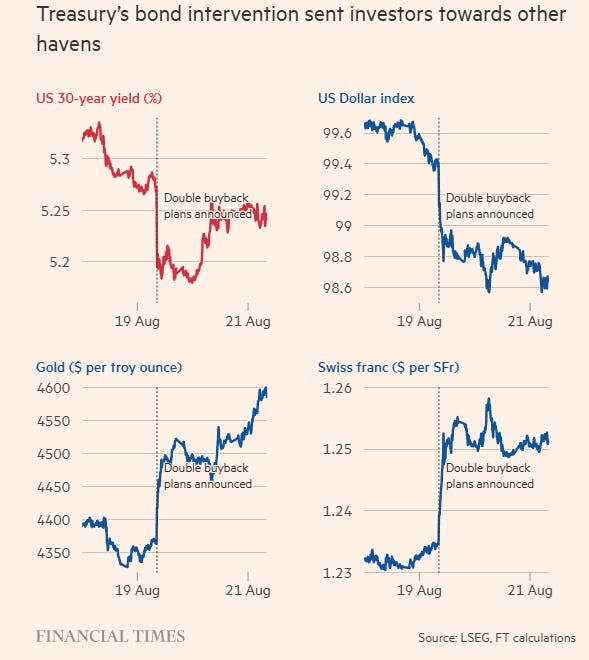
Katie Martin’s chart around the Bessent announcement shows the 30-year yield rising, the dollar falling, and both gold and the Swiss franc strengthening.
I wouldn’t declare that the world’s savings are heading for the exits. But April 2025 in no longer an anomaly either.
But I don’t know whether this is a dollar-demand issue, or a balance-sheet capacity issue. Those are not the same thing. It may be neither an either/or nor a distinction we can yet resolve from prices. A dollar-demand problem says foreigners no longer want U.S. claims. A capacity problem says they may still want dollar claims, but the marginal financial system no longer wants to warehouse U.S. duration at the old price. The second is much less dramatic. It may also be the one we are actually observing.
The reserve-currency question and the Treasury-duration question are no longer the same question.
July 29 post-FOMC press conference